Yellowstone Frequently Asked Questions
Answers to the most common questions about planning a Yellowstone trip.



Yellowstone National Park: Where to Go, What to See & When to Visit
Wildlife, wonders, and insider guidance from local guides who know the park inside out.
Visiting Yellowstone takes some planning. From figuring out which entrance to use to deciding when to go and what to prioritize, there’s a lot to sort through before you arrive. The questions below cover what visitors most often want to know, organized by topic so you can find what’s relevant to your trip.

Yellowstone Attractions & Scenery
Grand Prismatic Spring is the largest hot spring in the United States and the third-largest in the world, located in the Midway Geyser Basin in Yellowstone’s lower loop. It’s roughly 370 feet across and 160 feet deep.
What makes it famous is the color. The spring’s surface ranges from deep blue in the center to brilliant green, yellow, orange, and red around the edges. The colors come from heat-loving microbial mats (different bacteria thrive at different temperatures), with the cooler outer rings hosting the more vivid orange and red species.
The best view is from the Fairy Falls Trail overlook, a short uphill walk that puts you above the spring and lets you see the full color spectrum. The boardwalk at ground level is closer but doesn’t show the colors as dramatically because you’re looking across rather than down. Our Old Faithful, Waterfalls & Wildlife day tour and most multi-day tours include a stop here.
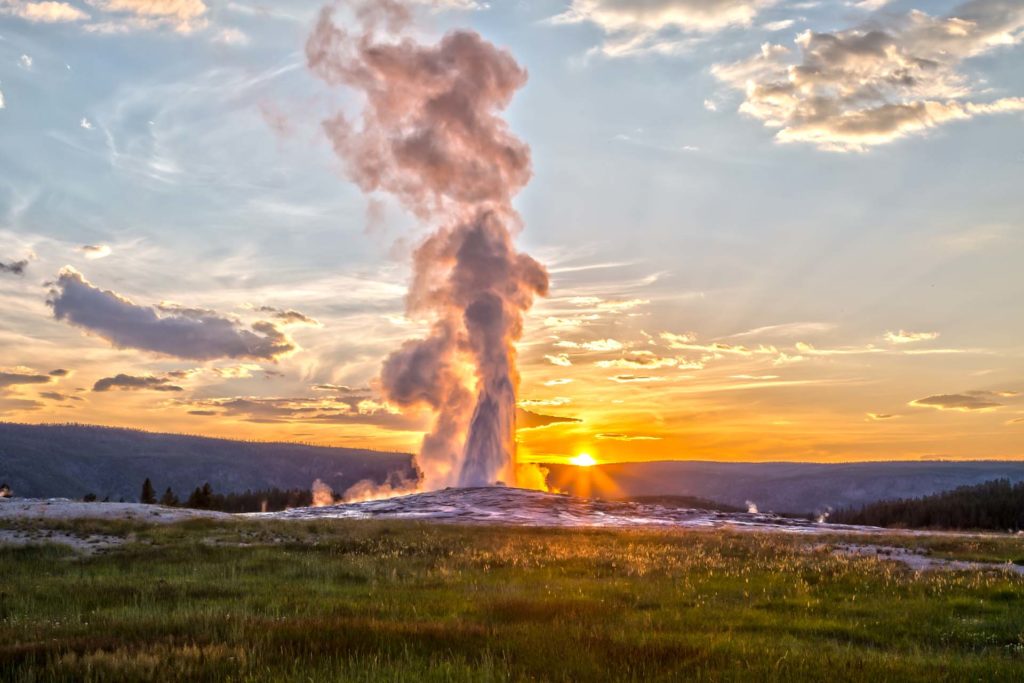
Old Faithful’s eruptions reach 100 to 180 feet tall and occur roughly every 90 minutes. The eruption itself lasts 1.5 to 5 minutes and releases between 3,700 and 8,400 gallons of boiling water.
The “faithful” name comes from the predictability, not the consistency. Park rangers can predict the next eruption within a 10-minute window based on the length of the previous eruption: longer eruptions are followed by longer intervals. Current predicted eruption times are posted at the Old Faithful Visitor Center and on the NPS Yellowstone app.
For the best experience, arrive 20-30 minutes before the predicted eruption to claim a spot on the boardwalk. The Upper Geyser Basin surrounding Old Faithful contains the highest concentration of geysers on Earth, with over 150 within a one-square-mile area, so plan to walk the boardwalks before or after the eruption to see Castle, Grand, and Riverside geysers.
The Grand Canyon of the Yellowstone is a 24-mile-long, up to 1,200-foot-deep canyon carved by the Yellowstone River, famous for its dramatic yellow, orange, and red walls (which is where the park’s name actually comes from, not the more famous Grand Canyon in Arizona).
Two waterfalls anchor the canyon. The Upper Falls drops 109 feet. The Lower Falls drops 308 feet, nearly twice the height of Niagara, and is the most photographed feature in the park after Old Faithful.
Key viewpoints include:
- Artist Point on the south rim, made famous by Thomas Moran’s 1872 paintings that helped convince Congress to create the park
- Lookout Point for the classic Lower Falls view
- Brink of the Lower Falls trail on the north rim, a short steep hike that takes you to the very edge of the cascade
The canyon is accessible year-round, with different experiences in each season. Summer shows the colors at their most vivid. Winter, when the falls partially freeze, offers a completely different and quieter experience. Our winter snowmobile tour accesses Artist Point and the falls overlooks when most visitors can’t reach them.
Most visitors stick to the major pullouts and overlooks, leaving the rest of the park’s 3,500 square miles relatively quiet. A few spots worth knowing about:
- Mystic Falls in the Upper Geyser Basin, a 70-foot waterfall reached by a 2.4-mile loop trail. Walkable in an hour and almost always empty.
- Lone Star Geyser, accessed by a flat 5-mile round trip on an old service road. Erupts roughly every three hours with crowds in the single digits.
- Pebble Creek Trail in the northeast, offering genuine backcountry feel within walking distance of the road.
- Point Sublime on the south rim of the Grand Canyon, a quiet viewpoint with the same dramatic views as Artist Point and a fraction of the visitors.
Timing matters too. Even the famous spots feel completely different at off-hours. Grand Prismatic at 7 a.m. is a different experience than Grand Prismatic at noon. For more, see our insider’s guide to Yellowstone’s hidden gems.
Yellowstone covers 2.2 million acres, or about 3,500 square miles, making it roughly the size of Rhode Island and Delaware combined.
The park spans three states, with the majority in Wyoming (96%), a small portion in Montana (3%), and a sliver in Idaho (1%). The main road system, called the Grand Loop, is a figure-eight covering 142 miles. Driving the full loop without stopping takes 4-7 hours depending on traffic and wildlife jams.
Distances inside the park are larger than most visitors expect. Old Faithful to Lamar Valley is over 2 hours one way. The North Entrance to the South Entrance is roughly 3 hours of driving. This is why we recommend at least 2-3 days for a meaningful visit, and why guided multi-day tours typically outperform self-driving for wildlife viewing: guides know where to position guests at the right times of day without wasting hours behind the wheel.
Mammoth Hot Springs is a complex of terraced travertine formations in the park’s northwest corner, created over thousands of years by hot water depositing calcium carbonate as it cools on the surface.
Unlike the more famous geyser basins in the park’s interior, Mammoth’s features are constantly changing. Springs shift, dry up, and erupt in new locations on a year-to-year basis, which means the terraces look different every visit. The site is also home to a resident elk herd that frequently grazes around the historic Fort Yellowstone buildings.
Mammoth is worth visiting if:
- You’re entering or exiting through the North Entrance (Gardiner, MT)
- You’re already touring the northern range and Lamar Valley
- You’re visiting in winter, when Mammoth is one of the few areas accessible by car
For visitors entering through Jackson or West Yellowstone, Mammoth requires a significant detour. Most BrushBuck multi-day itineraries include Mammoth when the route naturally passes through. For a quick reference on Yellowstone’s full lineup of attractions, see our stunning attractions guide.
Yellowstone is generally divided into five regions based on the Grand Loop road system, each with its own character and signature features:
- Mammoth & the Northern Range: Travertine terraces, the resident elk herd, and access to the Lamar Valley
- Lamar Valley & Northeast: “America’s Serengeti,” the wildlife capital with wolves, bison, grizzlies, and elk
- Canyon Village: Anchored by the Grand Canyon of the Yellowstone and Hayden Valley wildlife viewing
- Lake Country & Yellowstone Lake: The largest high-elevation lake in North America, plus West Thumb Geyser Basin
- Old Faithful & the Geyser Basins: The highest concentration of geothermal features on Earth, including Old Faithful, Grand Prismatic, and the Upper, Midway, and Lower Geyser Basins
Most first-time visitors prioritize Old Faithful and Canyon Village for the iconic landmarks, plus Lamar or Hayden Valley for wildlife. The Grand Loop is a figure-eight, so it’s possible to see all five regions in 3-4 days at a reasonable pace.
Navigation, Parking & Logistics
Yellowstone has five entrances, and the best one depends on where you’re flying in and what you want to see most.
- South Entrance (Jackson Hole, WY): Connects directly to Grand Teton National Park. The primary gateway for visitors combining both parks and the entrance most BrushBuck tours use.
- North Entrance (Gardiner, MT): The only gate open to wheeled vehicles year-round. Best access to Mammoth Hot Springs and Lamar Valley.
- West Entrance (West Yellowstone, MT): The busiest gateway, with quick access to Old Faithful and the major geyser basins.
- Northeast Entrance (Cooke City, MT): The best route to wildlife-rich Lamar Valley.
- East Entrance (Cody, WY): A scenic drive directly to the shores of Yellowstone Lake.
If you’re flying in, match your entrance to your closest airport: Jackson Hole (JAC) for the South, Bozeman (BZN) for the North or West, and Cody (COD) for the East. If you’re touring both Yellowstone and Grand Teton, the South Entrance through Jackson is almost always the right choice.
Inside the park, the only way to get around is by personal vehicle, tour bus, or guided tour. There is no shuttle service, no public transit, and no rideshare coverage.
The Grand Loop is a 142-mile figure-eight road system that connects the major attractions. The roads are paved and suitable for any vehicle in summer. Speed limits are low (45 mph maximum, often 35 mph or less) and wildlife jams can stop traffic completely for 30 minutes or more at a time.
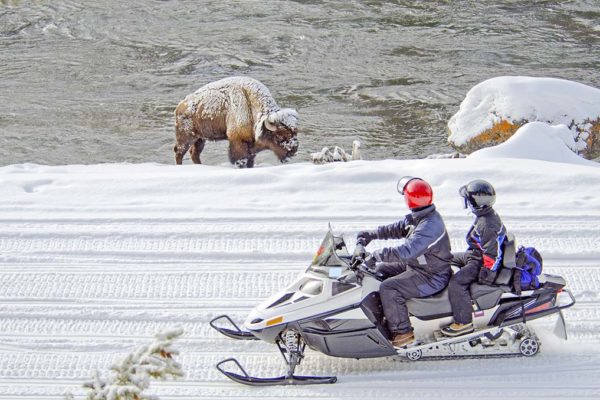
In winter, most interior roads close to passenger vehicles entirely. The only road that stays plowed year-round is the route from Mammoth to Cooke City through the northern range. Everything else becomes accessible by snowcoach, snowmobile, or skis only. Our winter snowcoach tours and snowmobile tours cover the interior during winter months.
Cell service in Yellowstone is limited and unreliable. Coverage exists in a few developed areas, but most of the park has no signal at all.
Areas with usable coverage include:
- Old Faithful Village
- Mammoth Hot Springs (limited)
- Canyon Village
- Grant Village
- Lake Village (intermittent)
Service is typically Verizon and AT&T only. T-Mobile and other carriers often have no coverage even in developed areas. Wi-Fi is available at some lodges and visitor centers, but speeds are slow and connection is unreliable.
Plan to be offline for most of your time in the park. Download maps before you arrive, share your itinerary with someone back home, and don’t rely on real-time GPS for navigation in the backcountry. The NPS Yellowstone app works offline once downloaded and includes the park map, geyser predictions, and points of interest.
Yellowstone is open 24 hours a day, 365 days a year, but road access changes dramatically by season.
- Summer (mid-April through early November): All park roads open. Most entrances and facilities operational.
- Winter (mid-December through mid-March): Only the road from Mammoth to Cooke City open to cars. All other interior roads accessible by snowcoach or snowmobile only.
- Shoulder seasons (April/early May, October/November): Partial access. Some roads still closed for snow removal or weather. Check current conditions before traveling.
Visitor centers and ranger stations have their own hours, typically 9 a.m. to 5 p.m. in summer with reduced hours in shoulder season. Many in-park facilities (gas stations, restaurants, gift shops) close entirely in winter.
For current road status, the NPS Yellowstone road conditions page is updated daily and is the only reliable source. Conditions can change with a single storm.
A 7-day vehicle pass to Yellowstone costs $35 per car. Individual passes for those entering on foot, bike, or motorcycle cost $20 per person.
Other options:
- America the Beautiful Pass: $80 per year, covers all national parks and federal recreation lands. Worth it if you’re visiting more than two parks in a year.
- Senior Pass: $80 lifetime for U.S. citizens 62 and older.
- Access Pass: Free lifetime pass for U.S. citizens with permanent disabilities.
- Military Pass: Free annual pass for active-duty military and dependents.
- 4th Grade Pass: Free annual pass for any 4th grader and their family through the Every Kid Outdoors program.
The vehicle fee is per vehicle, not per person, so a family of five pays the same $35 as a solo driver. On multi-day BrushBuck tours, park entrance fees are included in the tour price. Day tours typically exclude the entry fee, so plan to pay at the gate.
Most roads inside Yellowstone close to passenger vehicles from mid-December through mid-March. The only road that stays plowed and open to cars is the route from the North Entrance (Gardiner, MT) through Mammoth to the Northeast Entrance (Cooke City, MT).
Everything else, including Old Faithful, Grand Prismatic, the Grand Canyon of the Yellowstone, and the Lower Loop, is closed to wheeled vehicles. Access to these areas in winter is by:
- Snowcoach: Heated, tracked vehicles that travel groomed routes. The most comfortable option.
- Snowmobile: Guided snowmobile tours on the same routes.
- Cross-country skis or snowshoes: Available in some areas with the right experience.
Winter is when the park is most exclusive and most photogenic. Wolves are easier to see against snow, bison cluster around geothermal features for warmth, and the geysers erupt against frozen landscapes. The trade-off is access requires specialized transportation. Our winter tour packages cover the planning and equipment so guests can focus on the experience.
Parking in Yellowstone is first-come, first-served, with no reservation system. During peak summer months, lots at the major attractions fill by 9 or 10 a.m. and stay full until late afternoon.
The most challenging lots:
- Old Faithful: Multiple lots, but all fill quickly. Arrive before 8 a.m. or after 4 p.m. for reliable parking.
- Grand Prismatic Spring (Midway Geyser Basin): The lot is small and frequently full. The Fairy Falls Trail overlook has its own lot about a mile away and is often easier to access.
- Artist Point at the Grand Canyon: Limited parking, especially in summer. Try the South Rim Drive pullouts as alternatives.
- Mammoth Hot Springs: Generally easier, with multiple lots throughout the area.
Strategies that work: arrive at popular spots early or late, skip the lunch-hour rush (11 a.m. to 2 p.m.), and consider visiting lesser-known geyser basins like West Thumb that have ample parking. On guided tours, parking logistics become a non-issue. Your guide handles drop-off, pickup, and timing, which is one of the practical (if unglamorous) reasons guided trips outperform self-driving in peak season.
BrushBuck Tours & Booking
All BrushBuck tours include an expert wildlife guide, transportation in a comfortable vehicle, high-powered optics (binoculars and spotting scopes), and hotel pickup and drop-off.
Day tours additionally include snacks and a picnic lunch. Multi-day tours add:
- Hotel lodging for each night of the tour
- Breakfast each morning
- Park entrance fees
- All in-park transportation between sites
- Snacks and refreshments throughout
What’s not included on any tour:
- Personal travel to and from Jackson Hole (your flight, etc.)
- Alcohol and most dinners on multi-day tours
- Guide gratuity (10-15% of tour price is standard)
- Personal expenses (souvenirs, additional meals not listed)
Specific tour details are listed on each tour page. For full multi-day packages, browse our multi-day tour options for what each itinerary covers.
A private tour is just your party, with a guide and vehicle dedicated entirely to you. A small group tour is shared with up to 9 other guests on a fixed itinerary.
The key differences:
- Group size: Private tours range from 1 to 10 people in your party. Small group tours cap at 9 other guests plus yours.
- Flexibility: Private tours can adjust pacing on the day, linger at wildlife sightings, or make small route variations. Small group tours follow a set schedule to keep the group together.
- Age restrictions: Most small group multi-day tours require guests to be 6 or older. Private tours are open to all ages, including young children.
- Cost: Small group tours offer lower per-person rates. Private tours cost more per person, but the per-person rate drops as your party grows.
- Experience: Small group tours add a social dynamic with other travelers. Private tours feel more personal and customizable.
Both options follow the same core itineraries with the same level of guide expertise. Choose private if you have young kids, want maximum flexibility, or are traveling as a larger family or group of friends. Choose small group if you’re solo or a couple wanting the best value, and you enjoy traveling with other like-minded guests.
Pack for layers, weather variability, and walking on uneven terrain. Yellowstone weather can swing 40+ degrees in a single day, so flexibility is essential.
Essentials for any season:
- Layered clothing (base layer, insulating mid-layer, waterproof outer shell)
- Sturdy walking shoes or hiking boots
- Sunglasses, sunscreen, and a hat (sun is intense at altitude)
- Refillable water bottle
- Camera and extra batteries (cold drains them fast)
- Personal medications and any specialty items
Season-specific additions:
- Spring/Fall: Warm jacket, gloves, beanie, layered approach
- Summer: Rain jacket for afternoon thunderstorms, hat, sunscreen
- Winter: Insulated parka, snow pants, insulated boots, gloves, hand warmers, balaclava or face covering
BrushBuck provides binoculars, spotting scopes, water, snacks, and on multi-day tours all meals listed in the itinerary. Specific gear recommendations are sent to guests after booking, including a detailed seasonal packing list.
Tours run rain or shine. Weather is part of the experience, and many of the best wildlife viewing days happen in less-than-perfect conditions.
Wildlife is often more active in cooler, overcast, or rainy weather. Guides know how to position guests safely and comfortably regardless of conditions. Tours are only canceled or modified in cases of genuine safety concerns, such as:
- Lightning storms in exposed areas
- Heavy snowfall closing roads
- Extreme cold (below -20°F) affecting safety
- Wildfire smoke or evacuation orders
In these cases, BrushBuck will reschedule the tour, modify the itinerary to safer areas, or issue a refund according to the cancellation policy. Decisions are made based on real-time NPS road conditions and weather alerts, not forecasts.
For guests booking in shoulder seasons (April-May, October-November), check weather trends before traveling but don’t let a forecast deter you. Some of the most rewarding tours happen in conditions that send self-driving visitors back to their hotels.
Yes for both, with some tour-specific considerations.
For kids:
- Private tours are open to all ages
- Most public small group multi-day tours require guests to be 6 or older
- Day tours vary; check each tour page for specific age requirements
- Private tours are recommended for families with very young children for flexibility and pacing
For seniors:
- All BrushBuck tours are accessible to active seniors
- Tours involve some walking, primarily on boardwalks and short trails
- Mobility limitations should be discussed at booking so guides can plan accordingly
- The vehicles are comfortable with multiple stops, and most viewing happens from the road or short walks
Wildlife tours are by nature low-impact compared to backcountry hiking trips. You’re not summiting mountains or covering miles of difficult terrain. If you can walk a quarter-mile on a flat boardwalk and get in and out of a vehicle, you can enjoy a BrushBuck tour. For specific accessibility questions, contact our team before booking.
Yes. Private tours can be customized within reasonable limits, and specialty tours are available for specific interests.
Customization options on private tours include:
- Itinerary adjustments to focus on specific wildlife (wolves, bears, photography)
- Pacing changes (longer days, shorter days)
- Special photography schedules around sunrise and sunset
- Adding or removing specific stops based on guest preferences
Specialty tours we run year-round:
- Wolf-watching tours: Dedicated to wolf viewing in Lamar Valley
- Winter snowcoach tours: Heated, tracked vehicle access to the park’s interior
- Snowmobile tours: Guided rides to Old Faithful or the Grand Canyon
- Photography-focused tours: Slower pacing, sunrise/sunset positioning, optical support
For requests that fall outside our standard offerings (multi-week trips, large group charters, corporate retreats), reach out to our team directly to discuss what’s possible.
Day tours: 50% of the tour price is withheld for cancellations outside 48 hours; within 48 hours, 100% is charged.
Multi-day tours: 50% is withheld outside 60 days; within 60 days, 100% is charged.
The longer notice window for multi-day tours reflects the lodging, guide scheduling, and resource commitments those tours require. We recommend travel insurance for multi-day bookings, especially during peak summer dates.
In rare cases of BrushBuck-initiated cancellation (severe weather, road closures, safety concerns), the policy is different: guests receive a full refund or the option to reschedule at no cost.
Specific terms are confirmed at booking. If you need to change dates rather than cancel outright, contact us as early as possible – we can often accommodate date changes more flexibly than outright cancellations.
Wildlife Viewing & Safety
Yellowstone hosts the largest concentration of mammals in the lower 48 states, with 67 species of mammals, nearly 300 species of birds, and a full ecosystem of fish, reptiles, and amphibians.
The most-sought-after wildlife includes:
- Large mammals: Grizzly bear, black bear, gray wolf, bison, elk, moose, bighorn sheep, pronghorn
- Medium mammals: Coyote, fox, river otter, beaver, badger
- Birds: Bald eagle, golden eagle, osprey, sandhill crane, trumpeter swan, great gray owl
- Smaller wildlife: Marmot, pika, ground squirrel, weasel
Different species are visible at different times. Bears are most active spring through fall, with most going into dens for winter. Wolves are easiest to spot in winter against snow. Bison are visible year-round. Elk rut in fall makes them especially photographable in September and early October.
The best chance of seeing the widest variety of species is on a guided wildlife tour during the shoulder seasons, when animals are active but crowds are lighter.
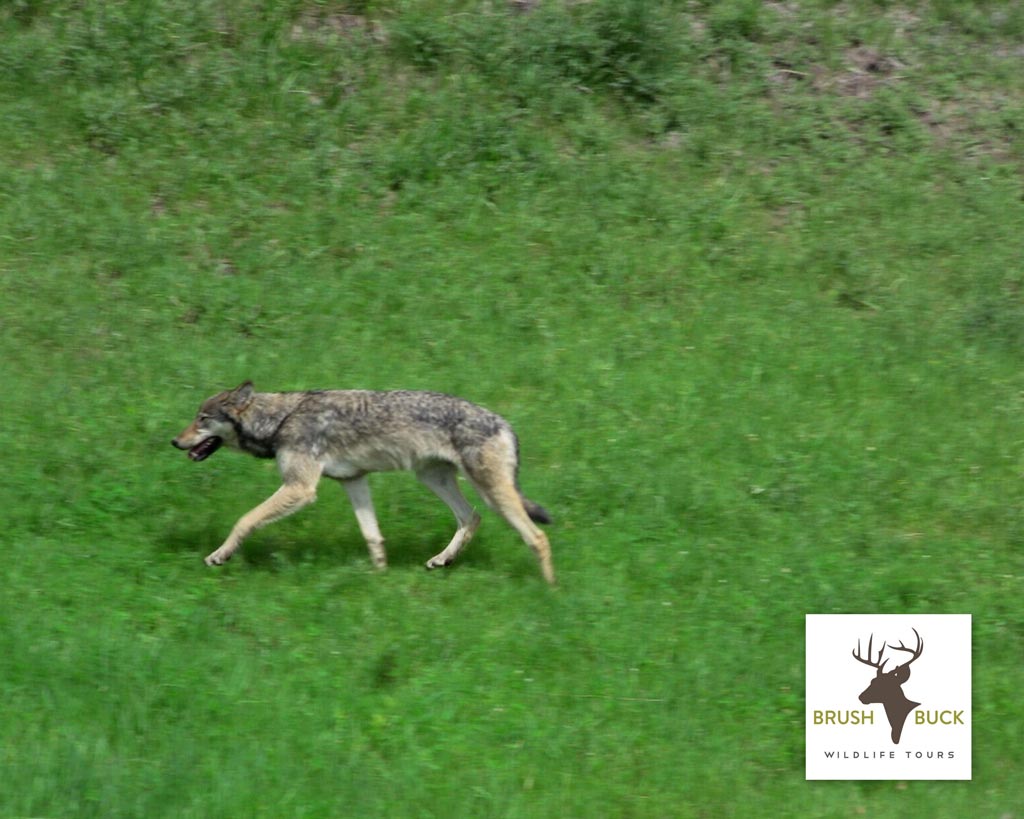
Lamar Valley in the northeast corner of the park is by far the best wolf-watching location in the lower 48 states. It’s home to multiple wolf packs and offers the open sagebrush terrain wolves prefer, which means they’re visible from the road in a way they rarely are in forested country.
Other good locations:
- Hayden Valley: Second-best wolf area, with packs that use the central park
- Slough Creek pullout: The most consistent single pullout for active wolf sightings
- Lamar Canyon pullouts: Multiple wolf packs use this area year-round
Wolves are typically visible at distances of half a mile or more, which means you need a high-powered spotting scope to actually see them well. Most self-driving visitors miss wolves entirely even when they’re present. Our 4-day Yellowstone Wolf Tour runs during the winter peak season when sightings are at their best.
Realistically, sighting rates depend heavily on season and approach. Spring and early summer (April through June) give the best odds, when bears are emerging from hibernation and actively foraging in open valleys. Fall (September-October) is the second-best window, with bears feeding heavily before winter denning.
Self-driving visitors might go a full week without seeing a grizzly, especially if they stick to the main attractions. Guided wildlife tours during prime months see grizzlies on a high percentage of trips, because:
- Guides coordinate sightings with other guides in real time
- Tours start before dawn when bears are most active
- Routes prioritize known bear country (Lamar, Hayden, the Tower-Roosevelt area)
- Guides bring optics that let you see bears at safe distances
Yellowstone is home to roughly 1,030 grizzlies in the greater ecosystem and over 1,400 black bears, the densest concentration of large mammals in the lower 48 states. They’re there. The question is whether you’re in the right place at the right time.
Yellowstone’s bison population fluctuates between roughly 4,000 and 6,000 animals, with recent surveys showing around 5,000. This is the largest free-roaming bison herd on public land in the United States.
The herd is genetically significant. Yellowstone bison are direct descendants of the original wild herds that once numbered in the tens of millions across North America, and they’ve never been crossbred with cattle. This makes them one of the only genetically pure bison populations in existence.
The bison range across the park year-round. The largest summer concentrations are in Hayden Valley and the Lamar Valley. In winter, bison move to lower elevations and cluster around geothermal features for warmth, creating some of the most iconic wildlife photography opportunities in the park.
Yes, with respect for distance and following park guidelines. Yellowstone wildlife has not been habituated to be safe around humans, and incidents almost always involve visitors who got too close.
The required distances:
- Bears and wolves: Stay at least 100 yards (the length of a football field) away
- All other wildlife (bison, elk, moose, etc.): Stay at least 25 yards away
Bison cause more injuries in Yellowstone than any other animal, by a large margin. They look slow but can run 35 mph and turn quickly. Most goring incidents happen because visitors approached for photos.
Other essentials:
- Carry bear spray in the backcountry and know how to use it
- Make noise when hiking to avoid surprising bears
- Never approach wildlife on roads (use telephoto lenses)
- Stay in your vehicle if wildlife is on the road near you
Guided tours add a meaningful safety layer. Guides know how to read animal behavior, position guests at safe distances, and avoid situations that put anyone at risk. Most reported wildlife incidents in Yellowstone involve self-touring visitors, not guided tour participants.
For wolf watching, late winter (February-March) is the peak month, with January and December close behind. Wolves are most visible against fresh snow, packs are most active during winter foraging, and crowds are at their absolute lowest.
Why winter outperforms other seasons for wolves:
- Visibility: Dark wolves stand out dramatically against white snow
- Activity: Winter is hunting season, with packs working together on elk herds
- Predictability: Packs concentrate around wintering elk in specific valleys
- No competition: Wolves face minimal human disturbance and behave more naturally
Spring (April-May) is the second-best window, when wolf pups become visible at den sites. Summer is the worst time for wolves; they retreat to higher elevations and become harder to spot.
For dedicated wolf-watching trips, we recommend our 4-day winter Yellowstone Wolf Tour, which runs during the peak February-March window when sighting rates are at their highest.
Winter is one of the best wildlife viewing seasons in Yellowstone, with several species more visible and more photogenic than at any other time of year.
The most active wildlife in winter:
- Wolves: Highly visible against snow, hunting elk herds in open valleys
- Bison: Cluster around geothermal features for warmth, creating dramatic steam-and-fur photos
- Coyotes: Active scavenging wolf kills throughout the park
- Elk: Wintering herds congregate at lower elevations in the northern range
- Bighorn sheep: Move to lower cliffs in winter, more accessible to viewers
- Bald eagles and golden eagles: Hunting and scavenging openly through the snow-covered landscape
Animals you won’t see in winter:
- Grizzly and black bears: In dens from roughly November through April
- Most songbirds: Migrated south
- Reptiles and amphibians: Hibernating
The trade-off for winter wildlife viewing is access. Most of the park’s interior is closed to cars, requiring snowcoach or snowmobile tours. The reward is a version of Yellowstone almost no one sees: empty roads, dramatic light, active predators, and animals behaving as they would without human presence.
Any More Questions?
We’d love to hear from you! Give us a call or leave us a message with our 1-minute form below and our staff will be in touch within 24 hours.
Featured Tours
Yellowstone Grand Canyon Snowmobile Tour
Available December – March
Grand Teton / Yellowstone 4 Day / 3 Night Wildlife Adventure
Available April – October
Yellowstone Winter Wolf Tour 4 Day / 3 Night
Available Dec – Mar